Sound & Signal
Tuning between stations and the map that was made of static
Moving a needle across a dial produced a landscape of noise, foreign voices and half-caught signals. Digital tuning goes straight to the destination.

Treat the sections below as a sequence. With tuning a radio dial, getting the early decisions right makes the later ones much easier.
Before you start
- Analogue tuning made the whole band audible, including everything between stations.
- Long-distance reception varies with atmospheric conditions and time of day.
- Digital tuning presents a list and removes the space between entries.
The dial was a continuous space
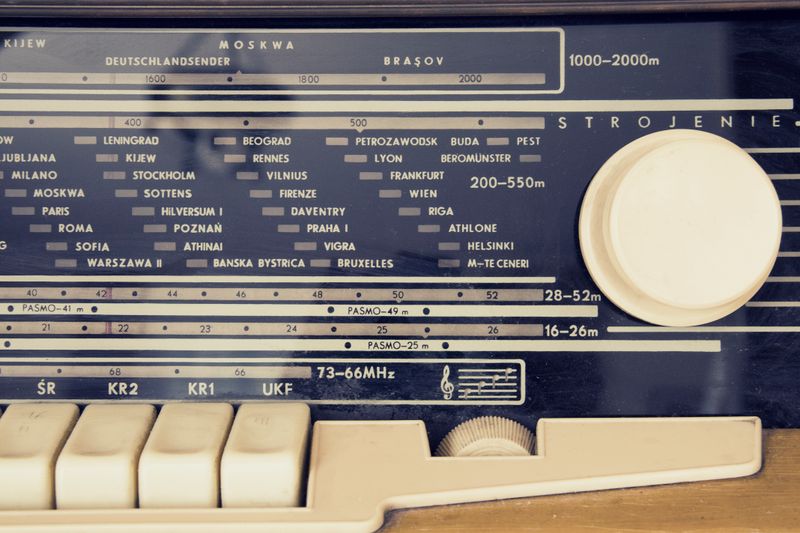
Turning an analogue tuner moved smoothly across frequencies, so a listener passed through every point between one station and the next. That produced noise, partial signals, whistles and the edges of transmissions that were never intended for that area. The physical dial also showed where stations sat relative to each other, which gave the band a spatial arrangement.
Printed city names on shortwave dials reinforced the impression that tuning was a form of travel. Digital tuning replaces this with a list of valid entries, so the space between stations no longer exists for the listener.
Distance reception depended on the sky
Certain frequencies reflect off layers of the upper atmosphere, which allows transmissions to reach far beyond the horizon. That reflection changes with the time of day, the season and solar activity, so the available stations differ hour by hour.
Night reception on medium wave in particular brings in distant transmitters that are inaudible during daylight. Listeners learned these patterns by experience and planned around them, which turned a receiver into an instrument for observing conditions. None of that knowledge is required to use a streaming service, which delivers any station regardless of physics.
Interference was information
Electrical appliances, overhead lines, thunderstorms and vehicle ignition systems all produced characteristic patterns of noise. Experienced listeners could identify the source of interference by its sound, which made a radio a crude diagnostic instrument.
Distant lightning is audible on some bands as sharp crashes, and the same phenomenon is used in atmospheric research. Modern equipment and digital transmission suppress most of this, which is better for listening and removes the incidental signal. The world stopped being audible through the receiver, which is a genuine and rarely noted change.
Searching produced things nobody chose
Anyone scanning a band encountered stations they had no intention of finding, in languages they did not speak. International broadcasters transmitted deliberately across borders, and reception reports from listeners were actively encouraged and acknowledged. Card acknowledgements confirming a received transmission were collected seriously, and that hobby still exists in a reduced form.
Look closer and the activity was a genuine form of discovery, because the listener could not know in advance what the band contained.
Recommendation systems attempt to reproduce discovery while removing exactly the property that made it discovery.
What the replacement does differently
Digital broadcasting and streaming deliver consistent quality, station names, programme information and no interference at all. Streaming removes geography entirely, making any station available anywhere, which is a far greater expansion of choice than tuning ever offered.
It also depends on data connection, account access and continued licensing, none of which applied to a receiver and an aerial. Broadcast radio requires nothing beyond a device and works when networks fail, which is why it remains part of emergency planning in many countries. A one-way transmission that reaches everyone simultaneously is difficult to replace for exactly that reason.
Memory is a poor archive, and it is most of what survives.
What the noise was for
The static between stations made the act of searching audible, so effort and reward were connected in a way a list removes. Finding something faint felt like an achievement because the listener had done the work of locating it.
That is a small thing and it is the specific pleasure people describe when they talk about old radios. Some streaming interfaces simulate tuning noise deliberately, which reproduces the sound and not the uncertainty. Uncertainty was the ingredient, and it cannot be added back to a system that always knows exactly what is available.
The takeaway
The static was not in the way of the stations. It was the distance between them, and it was the only part you had to cross yourself.
Nobody decided to stop. It simply stopped being worth the effort.
Questions readers ask
Why could you hear distant stations at night?
Certain frequencies reflect off layers of the upper atmosphere, and that reflection improves after dark. It varies with season and solar activity, which is why the available distant stations changed hour by hour.
Is broadcast radio still useful given streaming?
Yes, particularly in emergencies. It requires no network connection or account, reaches everyone in range simultaneously, and keeps working when data networks fail, which is why it remains part of emergency planning in many countries.