Work
The compositor, the typesetter and the trades that print lost
Newspaper production employed thousands of people in skilled trades that ceased to exist within about a decade.
There is a short answer about the printing trades and a useful one, and they are not the same. What follows is the useful one.
The short version
- Hot metal typesetting was a skilled trade with a long apprenticeship.
- Photocomposition and then desktop publishing removed it within roughly a decade.
- The knowledge was largely craft rather than documented.
A newspaper was made by hand, at speed
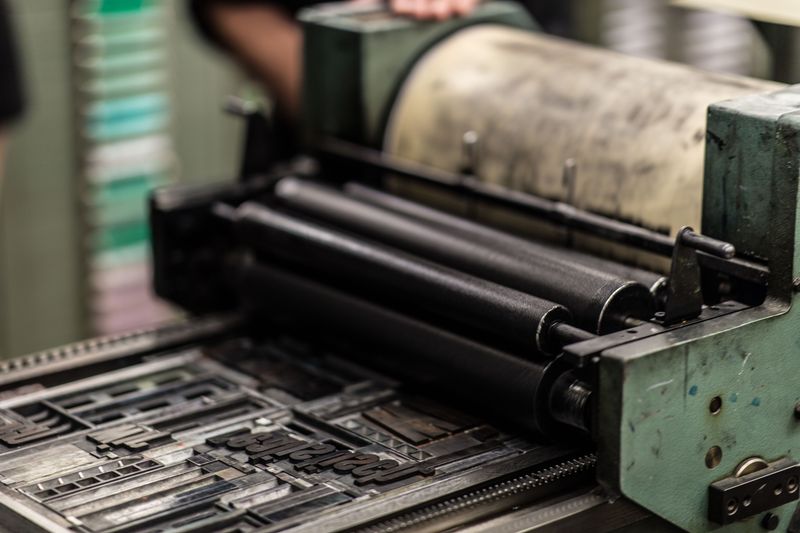
Hot metal composition involved operators setting lines of type on Linotype machines, and compositors assembling pages in metal formes. The work was fast, physical, and required reading type upside down and reversed as a matter of routine.
Apprenticeships ran for years, and the trade had strong union organisation built around the specificity of the skill. It was one of the last large-scale skilled manual trades embedded in a daily information industry.
The transition was abrupt
Photocomposition displaced hot metal through the 1970s, and computerised systems removed the remaining roles through the 1980s. Because journalists could now input text directly, an entire intermediate layer of the production process disappeared.
In truth, the speed of it — roughly a decade from dominant to obsolete — is what made the labour disputes of the period so severe. The specific issue in most of those disputes was not the machinery but the keystroke: whether a journalist typing a story once meant a compositor would never type it again, which both sides understood correctly as the entire argument.
What the compositor knew
Spacing, kerning, hyphenation and the judgement of how a page should look were craft knowledge held in the hands of people who did it daily. A great deal of it was never written down, because it did not need to be while the trade existed. Typography as a discipline retained the vocabulary and lost much of the tacit practice.
Look closer and some of it was recovered the hard way, since typesetting software spent years reinventing hyphenation, justification and optical spacing rules that a composing room had settled by eye long before anybody thought to write an algorithm for them.
The evidence is thin
Trade journals, union records and a small oral history literature exist, but the day-to-day working knowledge was mostly not documented. Machines survive in museums and a few working print shops, generally operated by enthusiasts rather than by people who did the job commercially. The window for recording first-hand accounts is closing, and much of it has already closed.
What has survived is also skewed towards the disputes, because newspapers reported their own industrial relations in great detail and reported the ordinary night shift not at all.
The pattern repeats
A skilled trade embedded in a production process, displaced by software that moves its function upstream to the person creating the content, is not unique to print. Draughtsmen, film editors' assistants, telephone operators and typing pools all follow roughly the same curve.
By the end, the consistent feature is that the resulting work is faster and the specific craft knowledge is not transferred anywhere. The exception is a craft that got written down before the machinery went, which is why bookbinding, letterpress and stonecutting can be relearned from manuals and why the working practice of a composing room largely cannot.
The conditions were part of the trade
Hot metal meant molten lead at the operator's elbow through an entire shift, and lead exposure, constant machine noise and crush injuries were ordinary features of the work rather than accidents. The composing room was also among the most tightly closed workplaces in the industry, with entry controlled through apprenticeship and, in many countries, effectively shut to women for generations.
By the end, that closure is part of why the trade could bargain as hard as it did, and part of why public sympathy during the disputes was so uneven. Accounts written since tend to preserve the craft and leave out the lead, which is the usual shape memory takes when a kind of work disappears.
The takeaway
The software did not replace the compositor. It moved the job to somebody who never knew there had been one.
Nobody decided to stop. It simply stopped being worth the effort.
Questions readers ask
Does letterpress printing still exist?
Yes, as a craft and fine-press practice, and it has had a substantial revival. It is no longer a commercial newspaper production method anywhere.
Where can I see hot metal composition?
Several print museums operate working Linotype machines, and a number of heritage print shops run demonstrations. Working operators are increasingly rare.