Objects
The typewriter and the sentence you had to finish in your head
A typewriter made revision expensive, which pushed the thinking earlier in the process. Word processors removed that pressure and changed what a draft is.

This looks at the typewriter from the practical end — what holds up once conditions stop being ideal.
What holds up in practice
- Impact printing made every character permanent and every correction visible.
- The staggered keyboard layout survives from a mechanical problem that no longer exists.
- Surviving machines depend on ribbons rather than on affection.
Ink went onto the page permanently
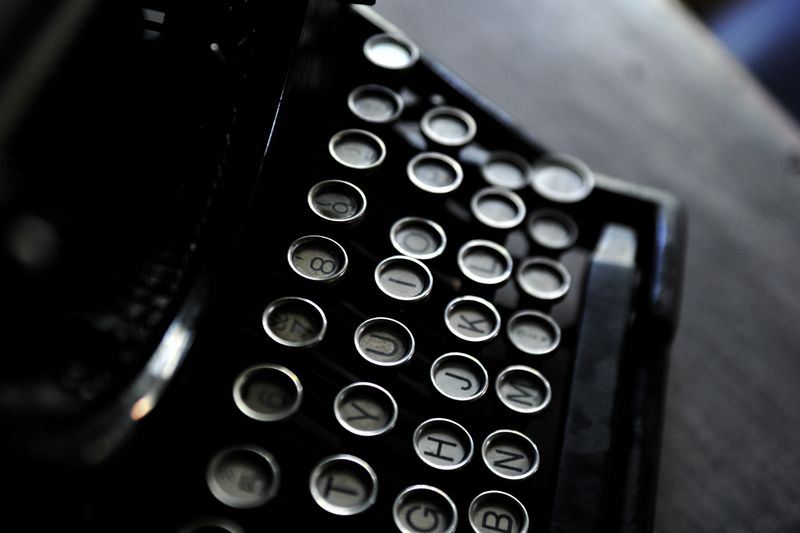
Each key drove a metal typebar against an inked ribbon, pressing a character into the paper hard enough to be felt on the reverse. Nothing about that action was provisional, because the ribbon transferred pigment that settled into the fibres rather than resting on the surface. Removing a letter meant abrading the paper with a gritty eraser, painting over it, or feeding a correction tape across the same strike.
Any of those repairs left a mark that a reader could find simply by tilting the sheet toward a window. The alternative was retyping the page from the top, which is why so many surviving drafts carry a single uncorrected mistake.
Correction was a supply problem as much as a skill
A working typist kept spare ribbons, correction paper and an eraser wheel within reach, because running out of any of them stopped the job. Correction ribbons lifted a character cleanly only if the machine could return the carriage to exactly the position it had struck.
Manual machines held no memory of where the previous strike landed, so the operator realigned the page by eye and accepted the result. Electric models that stored the last keystroke made single-character correction reliable, and buyers valued that feature more highly than raw typing speed. The competence being sold was accuracy before pace, because accuracy was the only thing that saved the whole page from a retype.
The cost of revision moved the thinking earlier
When altering a sentence costs a retyped page, the sentence tends to get settled in the head before the hands are allowed to move. Many writers drafted in longhand precisely so that the typing stage could be treated as transcription rather than as composition. That sequence produced prose with fewer abandoned clauses, because the abandoning happened on paper that nobody was expected to keep.
It also demanded the ability to hold a complete sentence in working memory, which is a specific and trainable habit rather than a talent. A word processor did not destroy that ability, but it did remove the daily obligation to practise it on everything you wrote.
The keyboard is the part that survived
The staggered key arrangement on almost every computer keyboard descends from machines that had to stop adjacent typebars from colliding. Its persistence is a clean example of a design outliving the mechanical problem it was built to solve by a very long margin.
Key travel, the audible click and the resistance under a finger were consequences of levers and springs rather than deliberate decisions about feel. Enthusiasts now pay to buy that sensation back, choosing switches engineered to reproduce something the original machines simply could not avoid producing.
The carriage return lever became a key, then an icon, and now names a character that no longer returns anything to anywhere.
What the replacement does differently
A word processor makes every version of a text equally cheap, so a document can remain unfinished indefinitely at no physical cost at all. Cutting and pasting permits structural rearrangement that a typist could only achieve with scissors, paste and another complete pass through the machine.
Look closer and automatic saving and revision history retain the discarded material instead of throwing it away, which quietly changes what the word draft means. The gain is genuine, because far fewer good ideas are now lost simply on the grounds that fixing them was too laborious. The loss is that a text rarely reaches the moment when somebody has to look at it and declare it finished.
Why the machines have not entirely gone
Typewriters still turn up in offices that need multipart forms completed, where a single impact marks the top copy and every sheet beneath it. They are also kept by writers who want a device incapable of delivering a message, an alert, a search result or an update. Repair remains plausible for a determined owner because the mechanism is visible, mechanical, and made of parts that a machinist can remake.
Ribbons are the real constraint, since they are consumable, often machine-specific, and produced by a shrinking number of remaining suppliers. An object that outlives its own industry usually survives or dies on the availability of consumables rather than on sentiment.
The takeaway
The typewriter did not teach anyone to write. It only made it expensive to change your mind, and that turned out to be a kind of instruction.
The loss is small and cumulative, which is why it goes unremarked.
Questions readers ask
Are typewriters actually better for writing?
There is no good evidence that the machine improves prose. What it reliably does is remove interruptions and make revision costly, which suits some working methods and frustrates others.
Why do computer keyboards still use the same layout?
Because typists were already trained on it and retraining an entire workforce was more expensive than keeping an arrangement that worked well enough. The jamming problem it solved disappeared with the typebars.