Work
The sign writer and the last hand-painted high street
Shop fascias were lettered by hand by people with brushes and no undo. Vinyl and print made signage cheap, uniform and quick to change.

Most explanations of the sign writer stop at the point where it starts to matter. This one carries on.
The short version
- Hand lettering required layout, spacing and letterform judgement in one pass.
- Vinyl cutting and digital print collapsed the cost of signage.
- The trade survives as a craft and heritage specialism.
The lettering was drawn, not selected
A sign writer set out a fascia by eye and by measurement, adjusting spacing so the word looked right rather than being mathematically even. Optical spacing differs from mechanical spacing, and getting it wrong is immediately visible to anybody even if they cannot say why.
Software applies default spacing that is usually acceptable and rarely optimal, which is why so much modern signage reads as slightly off. The judgement was in the hand and it took years to acquire.
There was no undo
Work was done in enamel on a fascia at height, in one pass, with a brush and a mahl stick to steady the arm. Corrections were expensive and visible, so the entire job depended on planning and confidence.
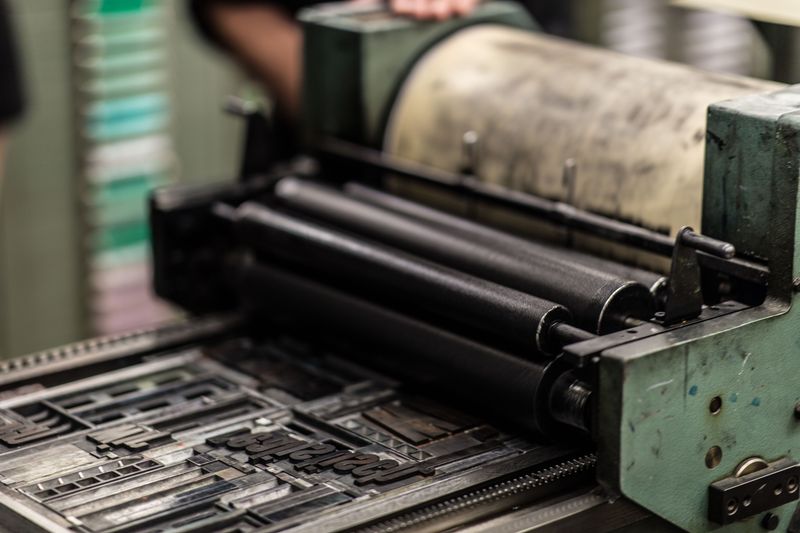
That is the same constraint that governed hand drafting and hot metal typesetting, and it produced the same kind of practitioner. Irreversibility as a discipline recurs across every craft that digital tools have absorbed.
Vinyl and print collapsed the price
Computer-cut vinyl and large-format digital printing reduced the cost of a shopfront sign by a large factor and the turnaround from days to hours. A small business could suddenly afford professional-looking signage, which is a real democratisation and is rarely acknowledged in laments about the craft.
The consequence is that high streets became more uniform, because the same fonts and templates were available everywhere. Cheapness and homogeneity arrived in the same delivery van.
Ghost signs are the surviving evidence
Painted advertising on brick walls, faded but legible, survives in most towns and records businesses and products that no longer exist. They persist because paint on masonry weathers slowly, and their rediscovery during demolition or renovation is a recurring local news item. Enthusiast groups document them systematically, since no official body does.
A commercial medium became an accidental archive of local commerce, which is not what any of the painters intended.
Regulation shaped what could be painted
Planning rules, conservation area controls and advertising consent govern shopfront signage in many jurisdictions and vary enormously between them. Conservation requirements have in places sustained demand for hand-painted signs where vinyl is not permitted. That means a craft survives partly because a regulator specified a material rather than a look.
Heritage protection is an unglamorous but effective employment scheme for traditional trades.
Dates in this period are approximate; the change was gradual and nobody logged it.
The revival is real and small
Hand lettering and sign painting have had a visible revival, driven by hospitality businesses buying visible craft as a signal of authenticity. That makes the work a premium product rather than a default, which changes both the pay and the customer.
What is easy to forget is that training is largely through short courses and apprenticeship with a small number of practitioners, since the trade route through employment has gone. A craft sustained by fashion is in a more precarious position than one sustained by necessity.
The takeaway
A street of hand-painted signs was a street where every fascia had been drawn once by a person who could not take it back.
What replaced it works. That is not the same as it being nothing.
Questions readers ask
Do sign writers still work by hand?
Yes, as a specialist craft, particularly for heritage buildings, conservation areas and businesses that want visible hand lettering. It is a premium service rather than the default.
What are ghost signs?
Faded hand-painted advertisements on building walls, surviving from earlier decades. They are documented mainly by enthusiast groups rather than by any official record.