Work
The proofreader and the last reader before the public one
Publishing once contained a formal stage where somebody read the text purely to catch what everybody else had stopped seeing.
There is a settled way of talking about the proofreader. It is worth asking how much of it survives contact with the detail.
The argument in brief
- Proofreading is a distinct stage from editing, with a different purpose and method.
- Print made errors permanent, which justified the cost of a dedicated reader.
- Continuous publishing allows correction and has removed most of the final check.
Reading proofs is not the same as editing
An editor works on argument, structure, clarity and accuracy, changing what the text says and how it is organised. A proofreader works on the final version against the previous one, checking that nothing was corrupted and no error survived.
The two jobs use different attention, and doing both at once reliably produces worse results at each of them. Proofreading also covers layout faults that have nothing to do with language, including bad breaks, missing captions and repeated lines. Treating them as one role, which is now common, quietly removes the second check rather than combining two checks.
Print made the stake permanent
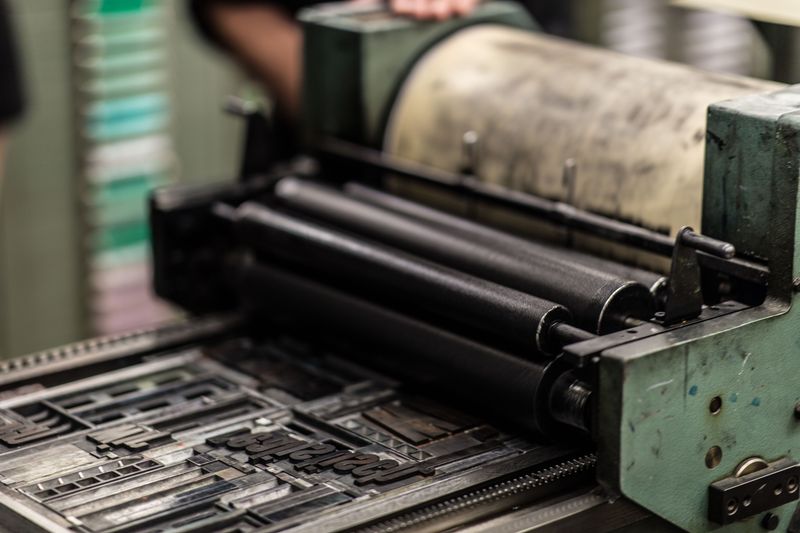
Once a run was printed, an error existed in every copy and could only be fixed by a correction slip or a reprint. That cost was substantial enough to justify a paid specialist reading every page before the presses were committed. Traditional practice used marks in the margin and in the line, a standardised notation that any compositor could act on without discussion.
Those symbols existed because instructions had to survive being passed between people who would never speak to each other. A notation designed for asynchronous work is a good idea that publishing had solved long before software rediscovered it.
Reading against the copy was a two-person job
The most reliable method involved one person reading the original aloud, including punctuation, while another followed the new setting. That catches transposition and omission far better than silent reading, because the ear notices what the eye completes automatically. The tendency of a reader to see the intended word rather than the printed one is the central difficulty of the entire task.
What is easy to forget is that professional practice compensates for it with slowing techniques, including reading backwards, using a ruler and changing the typeface. None of those tricks are obvious, which is why proofreading is a taught skill rather than a matter of being careful.
What the stage was really protecting
An uncorrected error damages credibility disproportionately, because a reader who finds one begins doubting the claims as well. For legal, medical, financial and technical publishing, a transposed figure or a dropped negative can be genuinely dangerous. Regulated sectors therefore retain formal checking stages, and those requirements vary by jurisdiction and by document type.
By the end, elsewhere the calculation changed once errors became correctable after publication at almost no cost.
That is a defensible trade, and it is rarely made explicitly or explained to the readers who encounter the errors.
What the replacement does differently
Automated checking catches spelling and much grammar reliably, and it catches nothing that is a correctly spelled wrong word. The residual errors are therefore the ones most likely to change meaning, which is an uncomfortable property for a safety net.
Continuous publishing allows silent correction, so the version a reader saw and the version now visible may differ without notice. That makes the record unstable in a way print never was, and archiving services exist specifically to address the problem. Correctability solved the cost of error and created a new problem about what the published text actually was.
Memory is a poor archive, and it is most of what survives.
Where the work went
Proofreading survives in book publishing, academic publishing, regulated industries and translation, usually as freelance rather than staff work. Rates and volumes have been pressed hard by the assumption that software has already done most of the job.
For a while, some of the function has migrated into review processes where colleagues check each other, which is cheaper and much less systematic. The most consistent finding of anybody who has done both is that a fresh reader outperforms a familiar one every time. Whatever the technology, the value was never in the marks; it was in a person who had not yet seen the text.
The takeaway
The job was never being careful. It was being the only person in the process who had not already decided what the sentence said.
The loss is small and cumulative, which is why it goes unremarked.
Questions readers ask
Is proofreading different from editing?
Yes. Editing changes what the text says and how it is structured. Proofreading checks the final version against the previous one for errors, corruption and layout faults. Doing both at once tends to produce worse results at both.
Can software replace a proofreader?
It reliably catches misspellings and much grammar, but not correctly spelled wrong words, transposed figures or dropped negatives. Those are exactly the errors most likely to change meaning.