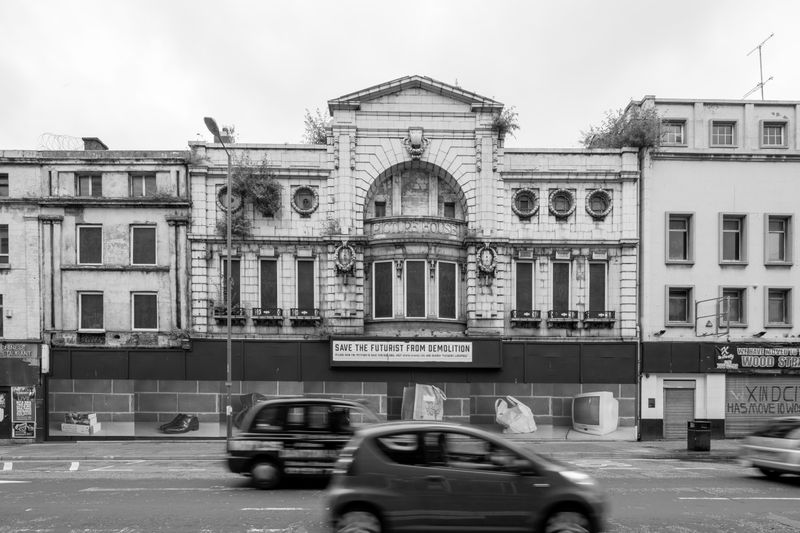
Places
The department store as a building the public was allowed to use
Tea rooms, lavatories, seats and warmth were provided free by a private business, and their closure removed a kind of indoor public space.
Treat the sections below as a sequence. With the department store, getting the early decisions right makes the later ones much easier.
Before you start
- Large stores supplied semi-public amenities with no purchase expected.
- Their closure removed indoor space that nothing has replaced.
- The amenity was funded by retail margins that no longer exist.
Amenities were the loss leader
A large store provided lavatories, seating, warmth, a tea room and often a nursery, none of which made money directly. The economics were straightforward: comfortable people stay longer and buy more, so the amenity was funded by the margin on everything else. When margins collapsed under online competition, the free part was the first thing that had to go.
The amenity was never charity, and understanding that explains exactly why it disappeared.
They functioned as indoor public space
People sheltered, met, waited, fed babies and used the lavatory without buying anything, and this was tolerated as a cost of trading. For older people and parents with young children, a warm indoor seat with a nearby lavatory is a significant urban resource. When stores close, that resource does not reappear anywhere, because no public body was providing it in the first place.
By the end, a privately supplied public good vanishes without any policy decision being taken.
The building was designed to be wandered
Escalators, atria, wide aisles and department adjacency were engineered to move people slowly through unrelated goods. The store sold discovery, which is the same product online retail struggles hardest to reproduce.
What is easy to forget is that recommendation systems attempt the equivalent and work from prior behaviour, which by construction narrows rather than widens. Walking past the hardware on the way to the linen is a different mechanism from being shown more of what you already bought.
They were civic institutions by accident
Many carried the founder's name, employed a large local workforce and hosted the town's Christmas display, exhibitions and community events. That gave a commercial building a civic weight it never formally held, which is why closures are reported as bereavements. The response in several towns has been to convert the buildings into libraries, colleges or council offices.
Those conversions preserve the public function and shed the retail entirely, which is a neat inversion.
The economics were structural, not managerial
Large floorplates in expensive town-centre locations carry high fixed costs that require high footfall to sustain. Once a substantial share of comparison shopping moved online, the model became difficult regardless of how well any individual chain was run. Business rates, rents and anchor-tenant lease structures made partial retreat difficult, so failures tended to be sudden and total.
Blaming individual management for a sector-wide structural shift explains very little.
How widespread this was is genuinely contested.
What is replacing them is not equivalent
Retail parks and warehouses shift shopping to places reachable mainly by car, which excludes anyone without one. Online delivery removes the trip entirely, which is convenient and eliminates the incidental social contact the trip contained. For people whose main outing of the week was a town-centre store, no substitution has been offered at all.
What is easy to forget is that that group is small in retail terms and significant in social ones, which is why the loss is felt unevenly.
The takeaway
Nobody voted to remove the seats and the lavatories from the middle of town. A retail model paid for them, and the model ended.
The loss is small and cumulative, which is why it goes unremarked.
Questions readers ask
Why did department stores fail?
Mainly structural: high fixed costs in expensive locations, a shift of comparison shopping online, and lease and rates structures that made gradual downsizing difficult.
What replaces the public amenities they provided?
Usually nothing directly. Libraries, community hubs and some shopping centres absorb part of it, but seating, lavatories and warmth in town centres have generally declined.